
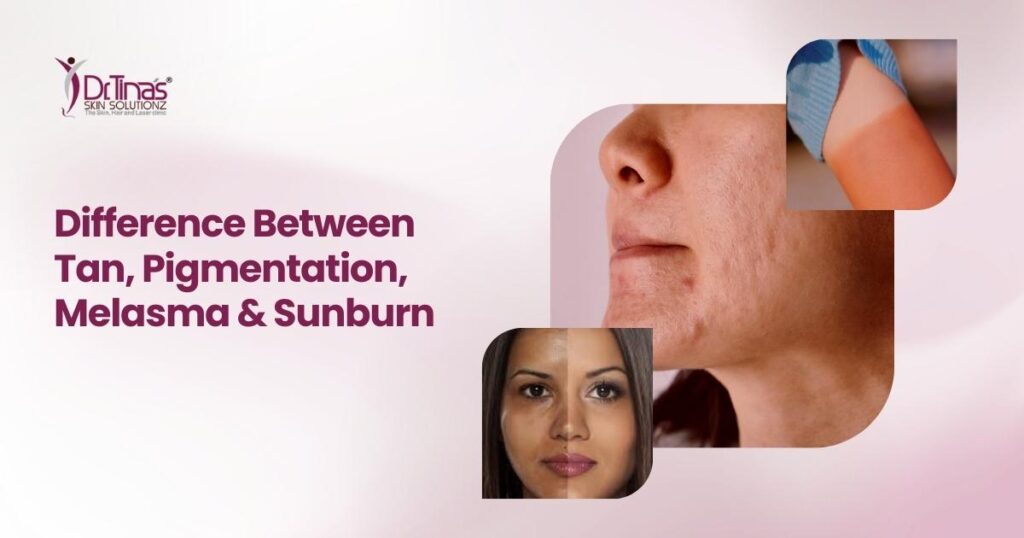
Difference Between Tan, Pigmentation, Melasma and Sunburn
“My skin has darkened after the vacation — is it a tan, or something more?”
If you’ve ever asked yourself this question while staring at your skin in the mirror, you’re definitely not alone. Every week, patients walk into our clinic at Dr. Tina’s Skin Solutionz with dark patches, uneven skin tone, or redness, and more often than not, they’ve already self-diagnosed the wrong condition. They’ve slathered on a de-tan face pack for weeks only to find the darkness isn’t fading. Or they’ve ignored a patch of discolouration that turned out to need medical attention.
Here’s the truth: tan, pigmentation, melasma, and sunburn are not the same thing. They look similar, they can co-exist, but they have very different causes and very different solutions. Let’s break it down in plain language; no medical jargon overload, we promise.
Table of Contents
How Skin Color Changes Happen
Skin color changes are mainly driven by melanin, the pigment that protects skin from ultraviolet radiation. Melanin is produced by melanocytes, and its behavior changes depending on the type of stress the skin faces.
There are three key biological responses:
- Protective response
Increased melanin production to defend against sun exposure. This results in tanning. - Inflammatory or injury response
Skin damage or inflammation triggers excess melanin during healing. Sunburn and post inflammatory pigmentation fall into this category. - Chronic dysregulation
Long term overactivity of melanocytes due to hormonal or genetic factors. Melasma is the classic example.
Another important factor is depth. Epidermal pigmentation affects the upper layers and responds faster to treatment, while dermal pigmentation lies deeper and is more persistent. This distinction is routinely assessed during consultation at Dr. Tina’s Skin Solutionz.
Understanding Each Condition in Detail
1. What is a Tan?
Let’s start with the most familiar one. A tan is your skin’s protective response to UV exposure. When you step out in the sun, UVA rays penetrate the deeper layers of your skin and stimulate melanocytes to produce more melanin. This darkens your skin, which is essentially your body throwing up a biological shield against further UV damage.
Tanning typically:
- Appears as a uniform, overall darkening of exposed areas like the arms, neck, face, and legs
- Develops gradually over days of sun exposure
- Is temporary and reversible, it can fade with proper skincare, exfoliation, and sun avoidance
- Is more prominent in people with medium to dark skin tones
Think of a tan as your skin’s way of saying, “I’m trying to protect you, but please, wear your sunscreen next time.” Mild tanning can fade within a few days to weeks once you’re no longer in the sun.
Must Read: How to Choose the Right Sunscreen for Your Skin Care
Quick test: If your entire exposed arm is uniformly darker after a beach trip and it’s starting to lighten as days pass, that’s a tan.
2. What is Sunburn?
Sunburn is a step up from tanning, and it’s not just cosmetic. It’s actual cellular damage.
While tanning is caused primarily by UVA rays, sunburn is driven by UVB rays that penetrate the outermost layer of skin (the epidermis) and directly destroy cellular DNA. Your skin responds with inflammation, and that’s what causes the redness, heat, and pain you feel after too many hours in the sun.
Sunburn typically:
- Appears as redness, tenderness, and warmth on exposed skin
- Can cause peeling, blistering, and swelling in severe cases
- Develops within a few hours of intense sun exposure
- Heals within a week but doesn’t disappear without leaving a mark repeated sunburns can lead to long-term pigmentation and even raise the risk of skin cancer.
Must Read: Complete Sun Protection Strategies to Prevent Skin Cancer
Quick test: Is your skin red, hot to touch, and painful after sun exposure? That’s sunburn — not a tan.
3. What is Pigmentation (Hyperpigmentation)?
Pigmentation is a broader term. It refers to any darkening of the skin caused by excess melanin production, which can be triggered by multiple factors not just the sun.
Types of hyperpigmentation include:
- Post-inflammatory hyperpigmentation (PIH): Dark spots left behind after acne, rashes, or skin injuries
- Sunspots / Age spots (Solar Lentigines): Small, flat, well-defined brown spots from cumulative UV damage over years
- Drug-induced pigmentation: Certain medications can cause skin darkening
- Melasma: A specific type of hyperpigmentation (we’ll talk about this separately)
Pigmentation differs from tanning in that it:
- Can appear on specific spots or patches, not uniformly across exposed skin
- Is often persistent and doesn’t fade without targeted treatment
- Can be caused by genetics, hormonal changes, inflammation, or medications not just sun exposure
Must Read: Guide For Skin Pigmentation Treatment Options
Quick test: Are the dark areas appearing in patches and not fading even weeks after sun avoidance? That’s likely pigmentation, not a tan.
4. What is Melasma?
Melasma is often the most misunderstood and, unfortunately, most mistreated of the four. It’s a specific form of hyperpigmentation that is multifactorial meaning it doesn’t have just one cause.
According to research published in StatPearls (NIH), melasma involves a complex interaction between UV radiation (including visible blue light from screens), hormonal influences, genetic predisposition, and the skin’s microenvironment.
Melasma is unique because:
- It appears as larger, blotchy, symmetrical patches, typically on both cheeks, the forehead, bridge of the nose, upper lip, and chin
- It has a grayish-brown to brown colour that looks deeper and heavier than regular tanning
- It is strongly linked to hormonal triggers, pregnancy (“the mask of pregnancy”), birth control pills, and hormonal therapies are major culprits
- It is significantly worsened by sun exposure, including UV light and visible light
- Family history matters; 55–64% of melasma patients have a family history of the condition
The tricky part? Melasma doesn’t respond to regular de-tan treatments or fairness creams. In fact, the wrong treatment can make it worse. And without addressing the root trigger (like ongoing sun exposure or hormonal imbalance), even the best melasma treatments will see relapse.
Quick test: Symmetrical patches on both cheeks and forehead that have been there for months and don’t respond to home remedies? That’s likely melisma, and it needs a dermatologist.
How to Tell What You Actually Have
Step by Step Self Check Framework
Timeline
- Sudden redness and pain indicates sunburn
- Gradual darkening after sun exposure suggests tanning
- Persistent dark patches after acne point to pigmentation
- Symmetrical facial patches that worsen with sun or hormones suggest melasma
Color and pattern
- Uniform color change suggests tanning
- Patchy or spot based discoloration suggests pigmentation
- Symmetrical facial patches suggest melasma
Sensation
- Pain or burning is common with sunburn
- No sensation is typical for tanning or pigmentation
Location
- Sun exposed areas for tanning and sunburn
- Acne prone areas for pigmentation
- Central face for melasma
Self assessment is helpful, but persistent or worsening discoloration should always be evaluated by a dermatologist in Bangalore with experience in pigmentary disorders.
Comparison Table: Tan vs Pigmentation vs Melasma vs Sunburn
| Comparison Metric | Tan | Pigmentation | Melasma | Sunburn |
| Main Cause | UV exposure as a protective response | Inflammation, acne, injury, or sun exposure | Hormonal imbalance triggered by sun and heat | Hormonal imbalance triggered by sun and heat |
| Depth of Skin Involvement | Superficial (upper skin layers) | Can be superficial or deeper | Often deeper and mixed depth | Often deeper and mixed depth |
| Duration | Temporary | Long term | Chronic and recurring | Chronic and recurring |
| Chance of Recurrence | Low if sun exposure is controlled | Moderate | High without strict maintenance | High without strict maintenance |
| Primary Treatment Focus | Sun protection and prevention | Correction plus prevention | Long term management and maintenance | Long term management and maintenance |
Can You Have More Than One at the Same Time?
Absolutely, and this is exactly why self-diagnosis can go wrong. It’s completely possible to have a tan on top of existing melasma, or post-inflammatory pigmentation aggravated by sun damage. This layering of conditions is exactly why a clinical examination matters. A dermatologist can assess the depth of pigmentation, identify triggers, and design a treatment plan that addresses all layers not just the surface.
Myths, Mistakes, and Claims You Should Avoid
When it comes to tanning and pigmentation, there is a lot of confusing advice online. Many people try multiple products or treatments before seeing a dermatologist, and often their skin becomes worse instead of better. Understanding these common myths can help you protect your skin.
Myth 1: One Cream Can Fix All Dark Spots
Many advertisements claim that one cream can remove tanning, pigmentation, melasma, and dark spots together.
The truth:
- Different dark spots have different causes
- Some are caused by sun, others by acne or hormones
- One product cannot treat all of them
What works better:
The right treatment depends on what type of darkening you have. A dermatologist can help identify this correctly.
Myth 2: Home Remedies Are Always Safe
Lemon juice, baking soda, toothpaste, and essential oils are often suggested online for pigmentation.
Why this is risky:
- These can burn or irritate the skin
- Skin irritation leads to more dark marks
- Damage may appear slowly over time
Better option:
Use products that are safe and recommended by dermatologists.
Myth 3: Lasers Can Permanently Cure Melasma
Many people believe that one or two laser sessions can completely cure melasma.
The reality:
- Melasma is a long-term condition
- It can improve but may come back
- Wrong laser treatments can make it worse
What helps:
Melasma needs long-term care, sun protection, and regular follow-up.
Mistake 1: Scrubbing or Exfoliating Too Much
People often scrub their skin hard or use strong exfoliating products to remove dark patches faster.
Why this is harmful:
- Scrubbing damages the skin
- Damaged skin becomes darker over time
- Pigmentation can worsen instead of fading
What to do instead:
Be gentle with your skin. Healthy skin clears dark marks better than irritated skin.
Mistake 2: Choosing Strong Treatments for Quick Results
Some clinics promise fast results using very strong peels or frequent laser sessions.
Why this is a problem:
- Strong treatments can damage the skin
- Skin may look better at first but worsen later
- Dark patches may return darker than before
Safer approach:
Slow and steady treatment works better and keeps skin healthy.
Be Careful of These Claims
Avoid clinics or products that promise:
- Guaranteed results
- Permanent cure for pigmentation
- Fixed results without checking your skin
Every person’s skin is different. Honest skin treatment focuses on improvement, not promises.
If something sounds too good to be true, it usually is. Skin darkening takes time to improve. Correct diagnosis, gentle care, and professional guidance are the safest way to get clear skin.
When to See a Dermatologist
You should seek professional care if:
- Pigmentation is persistent or worsening
- Melasma keeps recurring
- Sunburn leads to dark patches
- You are unsure about the diagnosis
At Dr. Tina’s Skin Solutionz, diagnosis is based on clinical evaluation, history, and skin analysis rather than assumptions.
Prevention That Actually Work
- Daily sunscreen use even on cloudy days
- Physical sun protection such as hats
- Stress and heat management
- Hormonal evaluation when indicated
Prevention plays a critical role in long term skin health.
Conclusion
Not all skin darkening is the same. Tanning, pigmentation, melasma, and sunburn differ in cause, depth, and treatment response. Correct diagnosis is the foundation of effective and safe care. Treating only the visible color without addressing the underlying trigger often leads to recurrence.
With evidence based protocols and decades of clinical experience, Dr. Tina Majumdar at Dr. Tina’s Skin Solutionz focuses on accurate diagnosis, ethical treatment, and long term skin health.
If you are struggling with tanning, pigmentation, melasma, sunburn, or any other skin concern, schedule a consultation at Dr. Tina’s Skin Solutionz in Bangalore.
Get expert guidance, personalized treatment, and trusted dermatology care tailored to your skin.
Book your skin consultation today and take the first step toward healthier, clearer skin.

Dr.Tina Ramachander is one of the best dermatologist in Bangalore and Medical Director at Dr.Tina’s Skin Solutionz, a skin care clinic in Bangalore. She completed her master’s in dermatology from the well acclaimed JJM Medical college in Karnataka and is now a practicising dermatosurgeon and Medical Cosmetologist in Bangalore.