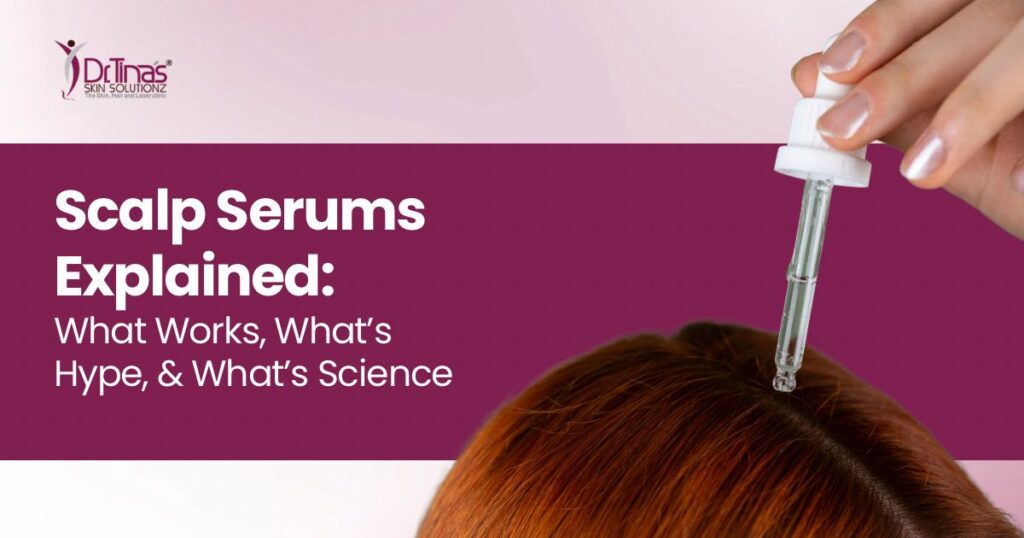
Scalp Serums Explained: What Works, What’s Hype, and What’s Science
Walk into any beauty store today or spend five minutes scrolling Instagram and you’ll see it:
Bottle after bottle promising:
- “Thicker hair”
- “Hair fall stopped in 7 days”
- “Hair regrowth miracle”
One product that keeps showing up everywhere is scalp serums.
Influencers swear by them. Brands position them as the ultimate solution for hair fall.
But here’s the question many people quietly wonder:
Do scalp serums actually work… or are they just another beauty industry trend?
As dermatologists, this is one of the most common concerns we hear from patients dealing with hair thinning.
The honest answer?
- Some scalp serums can genuinely help your scalp and hair health.
- Many others are simply clever marketing.
The difference comes down to one thing:
Science.
Let’s break down what scalp serums really do and how to identify the ones worth using.
What Exactly Is a Scalp Serum?
Many people confuse scalp serums with hair oils or hair serums, but they are very different.
A scalp serum is a lightweight treatment designed to deliver active ingredients directly to the scalp and hair follicles, where hair growth actually begins.
Key Difference:
- Hair oils: Coat and condition hair strands
- Scalp serums: Target the root environment of hair growth
What scalp serums aim to do:
- Stimulate hair follicles
- Reduce hair shedding
- Improve scalp circulation
- Strengthen hair roots
- Reduce scalp inflammation
- Support healthier hair growth cycles
However, their effectiveness depends entirely on the ingredients inside the formula.
Ingredients in Scalp Serums That Dermatologists Actually Trust
When choosing a scalp serum, ignore the marketing claims focus on the ingredient list.
1. Peptides
Peptides help support the hair growth cycle and strengthen hair follicles.
They can:
- Prolong the anagen phase (active growth stage)
- Reduce premature hair shedding
2. Caffeine
Yes—the same caffeine found in coffee.
Research suggests it may:
- Stimulate hair follicles
- Improve scalp microcirculation
While not a cure for baldness, it supports healthier follicles with consistent use.
3. Niacinamide
Niacinamide helps:
- Improve scalp barrier function
- Reduce inflammation
A healthy scalp environment is essential for maintaining hair density and strength.
4. Redensyl, Capixyl & Procapil
These advanced hair-growth complexes are increasingly used in dermatology-grade formulations.
They aim to:
- Support follicle stem cell activity
- Reduce inflammation around follicles
- Strengthen hair roots
While research is still evolving, they show promising results in early hair thinning.
Ingredients That Sound Impressive (But Often Don’t Do Much)
Not all ingredients are backed by strong evidence. Some are more about marketing than results.
1. Topical Biotin
- Helps only in true deficiency (which is rare)
- Limited evidence for effectiveness when applied to the scalp
2. Exotic Herbal Extracts
Examples include:
- Onion extract
- Bamboo extract
- Random botanical blends
These may:
- Improve hydration
- Soothe the scalp
But:
They lack strong clinical evidence for actual hair regrowth.
They’re not harmful but they’re not miracle solutions either.
When Scalp Serums Can Actually Help
Scalp serums work best in specific scenarios, not all hair loss cases.
They can help with:
- Early hair thinning
- Stress-related hair fall
- Post-partum shedding
- Mild inflammation-related hair loss
- Improving overall scalp health
They cannot reverse:
- Androgenetic alopecia (pattern hair loss)
- Alopecia areata
- Advanced or severe hair thinning
These conditions usually require medical treatment alongside topical support.
The Biggest Mistake People Make
Quitting too early.
Hair growth is a slow biological process.
Dermatologists recommend:
- Using a scalp serum for at least 3–4 months before evaluating results
Best practices for results:
- Apply on a clean scalp
- Massage gently for absorption
- Use once or twice daily (as directed)
- Stay consistent
Hair follicles respond to long-term stimulation, not quick fixes.
When Hair Fall Needs Medical Attention
If you notice any of the following, don’t rely only on cosmetic serums:
- Sudden excessive hair shedding
- Visible bald patches
- Receding hairline
- Widening partition
- Persistent itching or redness
Hair loss may be linked to:
- Hormonal imbalances
- Nutritional deficiencies
- Thyroid disorders
- Scalp infections or inflammation
A dermatologist can identify and treat the root cause, not just the symptoms.
The Bottom Line
Scalp serums are not magic potions.
But the right ones can:
- Support scalp health
- Slow early hair thinning
The key:
- Choose science-backed ingredients
- Use them consistently
And remember:
Hair fall is rarely just about the hair.
It’s about your scalp, hormones, nutrition, and overall health.
If You’re Struggling With Hair Fall in Bangalore
At Dr Tina’s Skin Solutionz, we take a science-first approach to hair loss.
Our approach includes:
- Clinical scalp analysis
- Evidence-based dermatology treatments
- Personalised home care protocols
So you don’t waste time or money chasing trends that don’t work.
Book a consultation today and discover what your scalp actually needs.

Dr.Tina Ramachander is one of the best dermatologist in Bangalore and Medical Director at Dr.Tina’s Skin Solutionz, a skin care clinic in Bangalore. She completed her master’s in dermatology from the well acclaimed JJM Medical college in Karnataka and is now a practicising dermatosurgeon and Medical Cosmetologist in Bangalore.