
Essential Questions to Ask Your Dermatologist for the Best Acne Scar Treatment Options

Acne scars are more than just skin-deep marks; they are complex textural changes that tell a story of past inflammation. While the acne itself may be gone, the scars often remain, affecting self-confidence and skin texture. If you are considering professional treatment, you likely know that the journey isn’t as simple as buying a cream off the shelf.
Asking the right questions during your consultation is the single most important step you can take. It shifts you from a passive patient to an active partner in your skin health. Whether you are visiting a renowned clinic like Skin Solutionz in Bangalore or consulting a local expert, knowing what to ask ensures you don’t fall for over-promises or settle for under-treatment.
This guide covers the essential questions to ask your dermatologist to ensure you get safe, effective, and value-driven results for acne scar therapy.
Why Asking the Right Questions Matters
Acne scarring is notoriously complex. Unlike active pimples, which are temporary infections, scars represent permanent structural changes in the collagen of your skin. Because scar types vary wildly—from deep “icepick” holes to wavy “rolling” hills—there is no single magic wand.
If you don’t ask the right questions, you risk undergoing “cookie-cutter” treatments that may not target your specific scar depth. Worse, you might face unexpected downtime or costs. A transparent consultation prevents this, ensuring your doctor explains why a specific laser or needle is being used on your face.
Quick 101: Types of Acne Scars & Why They Matter
Before you can ask intelligent questions, you need a basic vocabulary. Your dermatologist’s answers will often depend on which of these you have:
- Atrophic Scars (Depressed): These sit below the skin’s surface and are the most common.
- Icepick Scars: Deep, narrow pits that look like enlarged pores. They are notoriously hard to treat with surface lasers alone.
- Boxcar Scars: Broad depressions with sharp, defined edges.
- Rolling Scars: Wavy, uneven texture caused by fibrous bands pulling the skin down from underneath.
- Hypertrophic/Keloid Scars (Raised): Lumpy, raised tissue where the skin produced too much collagen during healing.
- PIH (Post-Inflammatory Hyperpigmentation): These are actually dark spots, not textural scars, and require a completely different approach (often chemical peels or brighteners).
Questions About Diagnosis and Assessment
Don’t let the doctor just glance at you and prescribe a laser. Dig deeper into their analysis.
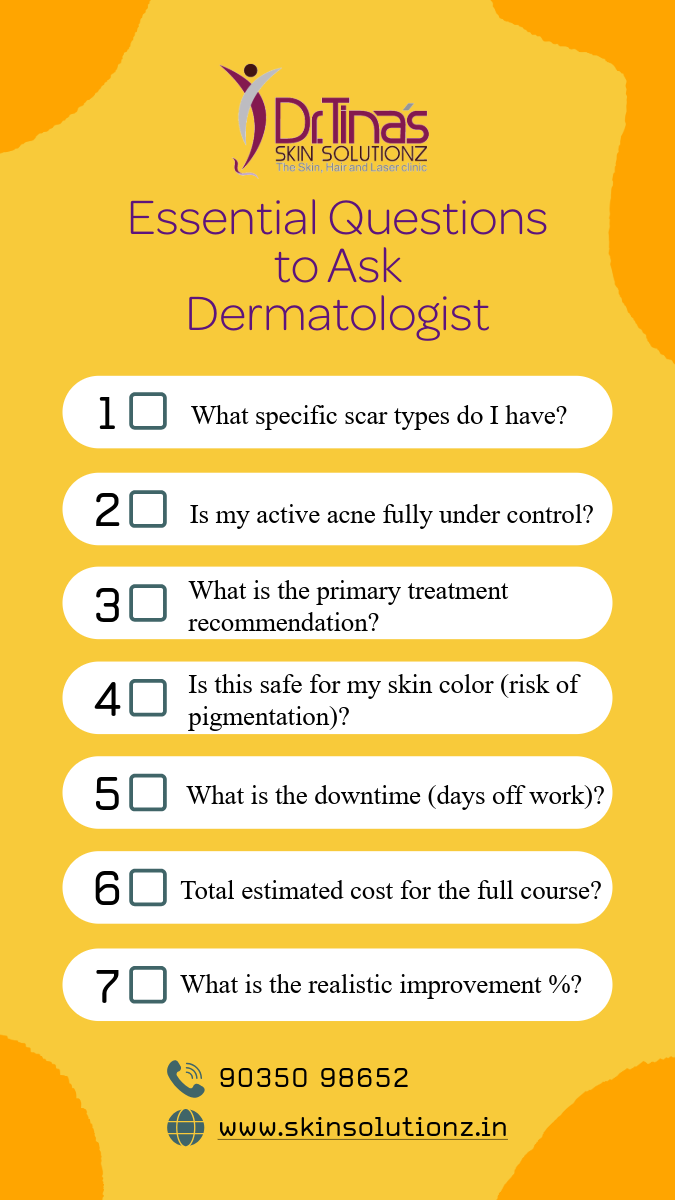
1. What specific type(s) of acne scars do I have?
Most patients have a “mixed bag” of scars. You might have rolling scars on your cheeks and icepick scars on your nose. A good dermatologist in Bangalore will map this out for you. If they treat all scars the same way, consider it a warning sign.
2. How deep are my scars, and what does that mean for treatment?
Depth dictates the tool. Surface peels won’t touch a deep icepick scar. You need to know if your scars are superficial (epidermal) or deep dermal, as this changes the cost and recovery time drastically.
3. Do I still have active acne that needs to be controlled first?
This is critical. Performing aggressive microneedling or laser resurfacing over active, infected acne can spread bacteria and cause more scarring. A responsible clinic, like Skin Solutionz, will often prioritize clearing active breakouts before starting scar revision.
Questions About Treatment Options
Once the diagnosis is clear, move to the solutions.
4. What are all the evidence-based treatments suitable for my scars?
You want options. Ask about:
- TCA Cross: For deep icepick scars.
- Subcision: For rolling scars (breaking the tethered bands).
- Microneedling / RF Microneedling: For overall texture improvement.
- Lasers (CO2/Erbium): For resurfacing boxcar scars.
5. What combination approach would you recommend and why?
Monotherapy (using only one method) rarely works for mixed scarring. Ask if you need a “cocktail” approach perhaps subcision first to lift the skin, followed by lasers to smooth the surface.
6. Which options are more aggressive vs. more conservative?
If you can’t afford a week of hiding your face (aggressive), ask for a “slow and steady” approach with milder treatments over more sessions.
Questions About Safety and Downtime
7. What are the possible side effects, especially for my skin tone?
This is crucial for Indian and darker skin tones. Aggressive lasers can cause PIH (Post-Inflammatory Hyperpigmentation) dark patches that appear after the burn heals. Ask specifically: “Is this laser safe for Fitzpatrick Skin Types IV-VI?”.
8. How much downtime will each treatment require?
Be precise. Does “downtime” mean just redness, or does it mean scabbing and peeling?
- Microneedling: Usually 1-2 days of redness.
- CO2 Fractional Laser: Can be 5-7 days of scabbing.
9. What lifestyle or work restrictions should I plan for?
Will you need to avoid the sun strictly? Can you wear makeup the next day? Knowing this helps you schedule your sessions around work or social events.
Questions About Results and Expectations
Managing expectations is the key to happiness in dermatology.
10. What improvement percentage can I realistically expect?
If a doctor promises 100% removal, run. Scar tissue never fully returns to virgin skin. A realistic, honest answer is usually 40% to 70% improvement, depending on severity.
11. How many sessions will I need?
Is this a “one-and-done” or a 6-month journey? Most collagen-induction therapies require 3–6 sessions spaced 4 weeks apart.
12. Will the scars disappear or just improve in appearance?
The goal is usually to make scars socially invisible (hard to see in normal light) rather than erasing them completely.
Questions About Technology and Clinic Expertise
13. Which devices and techniques do you use?
Clinics focused on advanced care, such as Skin Solutionz in Sahakarnagar, typically invest in FDA-approved, modern technologies like fractional lasers and MNRF (Microneedling Radiofrequency). Ask specifically why they chose their specific machine over others.
14. How experienced is the team with my specific scar type?
Experience matters more than the machine. A skilled hand performing subcision manually can sometimes achieve better results than a laser used poorly.
15. Do you have before-and-after photos of similar cases?
Look for photos of patients with your skin tone and your scar type. Generic stock photos are a red flag.
Questions About Cost and Value
16. What is the total estimated cost of my treatment plan?”
Don’t just ask per session. Ask for the full “project” cost. Scars often require 4-6 sessions, and knowing the total investment upfront prevents sticker shock.
17. Are there lower-cost alternatives?
If lasers are out of budget, ask about derma rollers or chemical peels. They are slower but can still be effective for certain superficial scars.
18. Can we structure the plan in stages?
A patient-centric clinic will often allow you to pay per session or offer packages to make the treatment more accessible.
Questions About Home Care and Maintenance
Your work doesn’t end when you leave the clinic.
19. What skincare routine should I follow before and after?
You may need to “prime” your skin with a retinoid or Vitamin C serum for weeks before a laser treatment to prevent pigmentation issues.
20. What can I do at home to maximize results?
Ask about sunscreen (non-negotiable), moisturizers, and gentle cleansers that won’t irritate healing skin.
21. What should I absolutely avoid?
Common answers include: direct sun exposure, picking at scabs, and using active acids (AHAs/BHAs) immediately after a procedure.
Red-Flag Answers to Watch Out For
During your Q&A, be wary if you hear these responses:
- “We can remove your scars completely.” (Impossible; improvement is the goal).
- “One treatment fixes everything.” (Rarely true for scarring).
- Dismissing pain or downtime: If they say “it’s painless” for a deep laser without numbing cream, they aren’t being transparent.
- Pressure tactics: You should never feel forced to sign up immediately.
Final Thoughts
Treating acne scars is a journey of patience and science. By asking these questions, you ensure that your treatment plan is customized to your skin, budget, and lifestyle. If you are in Bangalore, clinics like Skin Solutionz are known for this type of detailed, patient-first diagnostic approach, helping you navigate the complex world of scar revision with confidence.

Dr.Tina Ramachander is one of the best dermatologist in Bangalore and Medical Director at Dr.Tina’s Skin Solutionz, a skin care clinic in Bangalore. She completed her master’s in dermatology from the well acclaimed JJM Medical college in Karnataka and is now a practicising dermatosurgeon and Medical Cosmetologist in Bangalore.